
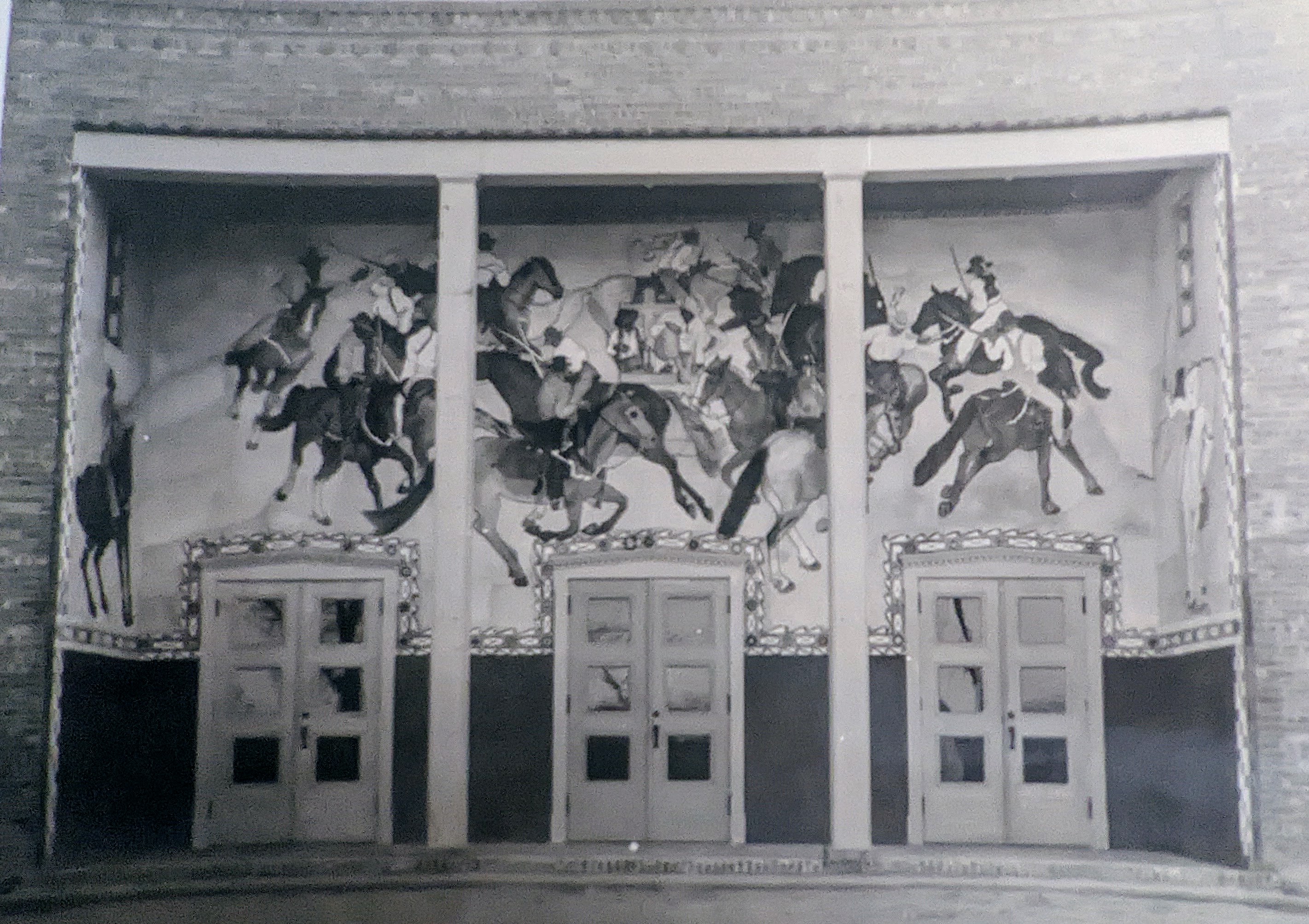
Having just returned from a month-long trek through Spain, I was inspired to revisit the story of how Dorothy’s mural on the Albuquerque Little Theatre came to be, along with the history of the scene which graced the facade until the 1950s, when the building was renovated. Sadly, all that remains of her original artwork are photographs, none of which illustrate the magnitude of her technicolor display.
Now that I have learned more about Spain’s history and the contribution that the Arab Moors made on its rich cultural heritage, I have a better understanding about what Dorothy’s choice of subject matter was and why.
When renowned Southwest architect John Gaw Meem approached artist Dorothy Stewart about painting a mural on the facade of the newly constructed Albuquerque Little Theatre—a New Deal project under Franklin D. Roosevelt’s Works Project Administration (WPA)–she whole-heartedly accepted. The building, designed by Meem, was to be constructed just south of Old Town—the historic center of the city— on 224 San Pasquale SW, where the building still stands today.
The idea for a community theater was born in 1927 by up-and-coming Broadway actress Katherine Kennedy O’Conner and a local reporter Irene Fisher, and was amongst the first of its kind in the United States. For the first six years of its existence, the determined thespians rehearsed and performed in public spaces such as the American Legion and community centers, though they lacked a permanent stage.
Desiring a home for the theater, ALT Board President, U.S. Senator Clinton P. Anderson, alond with several others, began seeking government funds for the project. However, it was Mrs. Ruth Hanna McCormick Simms, a prominent arts patron, activist, and politician, who personally hired John Gaw Meem to draw up the architectural plans. In true community spirit, land and lumber were donated by local businesses and citizens, leaving only the cost of construction to the WPA.

The building was grand. Measuring 160’ x 63’ feet, the auditorium could seat over 400 people, and the elegantly painted lobby featured four bathrooms and elaborate decorations. The large wooden stage, constructed of top-grade fir, provided ample performance space with a six-foot proscenium extending over an orchestra pit. Unfortunately for the actors, it lacked dressing rooms and bathrooms initially, so for several years the cast utilized an old box car behind the theater. That was remedied several years later when a single bathroom was moved backstage from the lobby. The facade of the building had a shallow porch with recessed upper walls, and it was here that Dorothy worked her magic. (Source: Ray, Terry. The Albuquerque Little Theatre. New Mexico Quarterly, Volume 30, Issue 1. Spring, 1960.)
Since Federal projects required artists to celebrate regional history, Dorothy proposed a scene from an outdoor drama that had been performed in the village of Santa Cruz, New Mexico on May 3rd—Holy Cross Day—since 1598, making it the oldest play performed on North American soil. Titled “Los Moros Y Cristianos”, it recounted a battle between the Arab Muslims who had settled across Spain beginning in 711 AD after easily overpowering the Visigoth King Roderick and his troops. For centuries, the Moors flourished in Southern Spain and the city of Cordoba became one of Europe’s most advanced civilizations. However, throughout that time, Christian forces attempted to expel Jewish and Muslim communities until eventually, in 1492, under the rule of King Ferdinand and Queen Isabella, the last remaining Muslims were driven out of Granada.

The recounting of the Spanish victory over the Moors was brought to the New World by the colonizer of New Mexico, Don Juan de Oñate, and local townspeople, of both Mexican and Spanish descent, recreated the drama in the central plaza. (Credit DNS. Linocut, 1936.)
It was a spectacle; eight or more horse and riders—each side distinguished by colored ribbons—Christians in white and Moors in red. Following a lengthy speech, the army “Captain” climbed up a cross, making way for the opposing armies to charge, circling each other in a dizzying array of movement, accompanied by the sounds of staccato drumming and clashing swords.


(Dorothy’s preliminary sketches for the the mural)
Dorothy moved to Albuquerque in April 1936, where she resided for the summer at Los Poblanos, Ruth Simms and her husband Albert’s 800-acre ranch. (More on that in another post. It’s an amazing place and continues to operate as a boutique hotel, fine-dining restaurant, and working lavender farm. )

Due to time constraints and the large scale of the project—900 square feet—Dorothy was given two assistants: Mexican muralist Samuel Moreno from Albuquerque and Rudi Staffel, a potter from San Antonio, Texas. The work was demanding and the artists worked from sun-up to sun-down in the plaster dust and heat of the August New Mexican sunshine.
Dorothy had chosen the challenging “true fresco” as the medium, which required both speed and accuracy, for once the paint pigments dried on the wet plaster, the image was set and could not be corrected without digging out the plaster.

Despite logistical setbacks and difficult working conditions, the finished product, saturated with bold colors and a sense of movement influenced by the dramatic style of Diego Rivera, drew high praise from theater members, the community, and local newspapers alike.
Not only was our experience in Spain wonderful for its unique character and evolution, once again, Dorothy has provided a personal connection for me to appreciate its vast and storied history.
Leave a Reply